Showing posts with label silence. Show all posts

Wednesday, September 20, 2017

How the Light Gets In . . . and Out

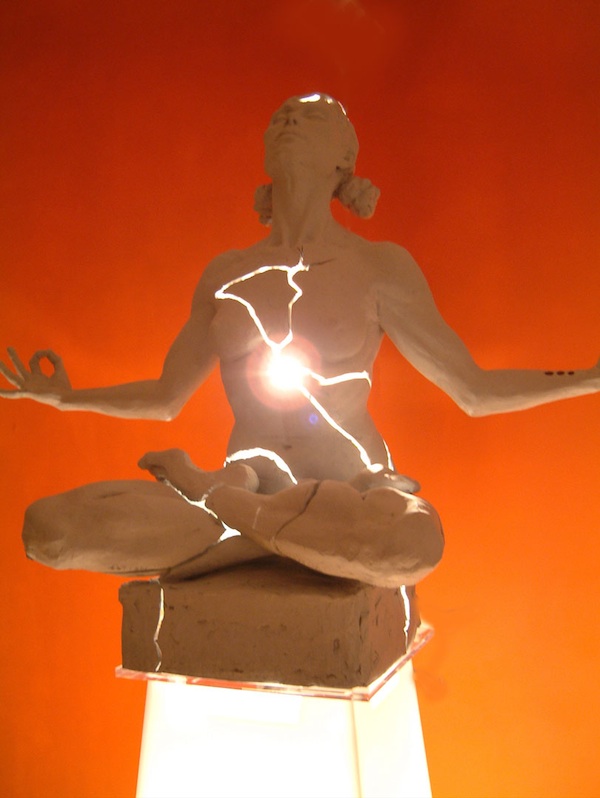
Expansion by the artist Paige Bradley.
Read the story behind this sculpture here.
Ring the bells that still can ring
Forget your perfect offering
There is a crack in everything 
That's how the light gets in. ~ Leonard Cohen


For the past few days I have been bombarded by Leonard Cohen's Anthem.  The lyrics come to me in words read in books and spoken by friends, in glimpses of ill-fitting doors and crumbling stone walls. Forgetting, accepting and perhaps even embracing imperfection is an ongoing struggle for me. When I learned that as a 7 on the Enneagram, in times of stress I got to a 1, The Perfectionist, it was a major "a ha, oh s*&!" moment. It gave me a gift of awareness.  When I get frustrated that I'm not perfect, that what I create isn't perfect, I'm not functioning out of my deepest, truest, inner self.

This has been something I've been pondering a lot lately as I get more serious about my writing. I can't just move poems from my head to the page to the world. I have to move them from my heart and my soul as well. It took me a long time to understand  intellectually and viscerally what so called "brave" writing looks like. And it's taking even longer for me to be able to write that way myself.

It helps to read honest, courageous writers. Lately the poets Claire Askew, Kaveh Akbar and Benjamin Garcia have been helping. My friend Randon Billings Noble's essay "The Heart is a Torn Muscle" has helped. Conversations with friends and companions has helped. Sitting in silence has helped.

Sitting in silence has probably helped the most because you can't help but encounter your imperfections there. In the silence the cracks let in light that compels us to peer into those dark and dank corners of our psyche we would rather ignore. It is usually uncomfortable. It is often brutal. And it will likely open even larger cracks but this is the thing I have learned:  the cracks are not only the way the light gets in, they are the way the light gets out.

Tuesday, March 19, 2013

An Invitation to Silence

Keeping Quiet by Pablo Neruda trans. by Stephen Mitchell from Full Woman, Fleshy Apple, Hot Moon:  Selected Poems (Harpercollins)

Now we will count to twelve
and we will all keep still.

This one time upon the earth,
let's not speak any language,
let's stop for one second,
and not move our arms so much.

It would be a delicious moment,
without hurry, without locomotives,
all of us would be together
in a sudden uneasiness.

The fishermen in the cold sea
would do no harm to the whales
and the peasant gathering salt
would look at his torn hands.

Those who prepare green wars,
wars of gas, wars of fire,
victories without survivors,
would put on clean clothing
and would walk alongside their brothers
in the shade, without doing a thing.

What I want shouldn't be confused
with final inactivity:
life alone is what matters,
I want nothing to do with death.

If we weren't unanimous
about keeping our lives so much in motion,

if we could do nothing for once,
perhaps a great silence would
interrupt this sadness,
this never understanding ourselves
and threatening ourselves with death,
perhaps the earth is teaching us
when everything seems to be dead
and then everything is alive.

Now I will count to twelve
and you keep quiet and I'll go.


Last week I led the Christian part of an interfaith meditation event for 40 or so participants.  The first presenter was a lovely Buddhist monk from Sri Lanka who guided us in a loving-kindness meditation for about 25 minutes.  I then gave a brief history and introduction to Centering Prayer and we sat in silence for another 20 minutes. 

 I'm used to sitting in silence with others, I do it almost every Tuesday evening.  And I often take the power of collective silence for granted until I talk to someone who is new to the experience, as was the case with my monk friend.  It's probably my own ignorance about his particular tradition within Buddhism and the type of meditation he practices, but that kind of surprised me.  Afterall, here was a man of a certain age, who has spent his adult life living all over the world and teaching meditation, saying that he'd never had an experience of collective silence like that before.  He talked about how there was an energy in the room that was powerful, yet at the same time deeply still and quiet. 

It's often the same way on Tuesday evenings in the Center for Prayer and Pilgrimage.  When we shut the outer doors, dim the lights, and sound the prayer bowl, a palpable hush falls over the room.  Often the longer we sit, the more I feel myself descending into that energy almost as if I'm being taken down into the depths of silence in an elevator or sinking into it like a fathomless pool of warm water. 

I can't imagine what that silence would feel like if, as Pablo Neruda suggests, the whole world agreed to be still and quiet at the same time.  The logistics alone would probably prevent that from ever happening.  But maybe we can experiment on a small scale. 

So here's what I'm proposing.  Tonight, 19 May, 2013, from 6:40 - 7 pm EST, I invite you to sit in silence.  If you want to sit with others and you're in the DC area, feel free to join us in the Center for Prayer and Pilgrimage at Washington National Cathedral.  If not, just find a comfortable place and take those twenty minutes to sit and be quiet.  It doesn't matter what you do in those twenty minutes-- Centering Prayer, metta meditation, mantra meditation, focusing on your breath, listening, whatever-- as long as you're quiet and still.  Let's see if even a little collective silence can interrupt the sadness and make us more alive . . .


Monday, March 18, 2013

The Shifting Sands of Silence

Ignorance by Philippe Jaccottet trans. by Derek Mahon from Words in the Air (Gallery Press)
The older I grow,the more ignorant I become,
the longer I live, the less I possess or control.
All I have is a little space, snow-dark
or glittering, never inhabited.
Where is the giver, the guide, the guardian?
I sit in my room and am silent:  silence
arrives like a servant to tidy things up
while I wait for the lies to disperse.
And what remains to this dying man
that so well prevents him from dying?
What does he find to say to the four walls?
I hear him talking still, and his words
come in with the dawn, imperfectly understood:

'Love, like fire can only reveal its brightness
on the failure and the beauty of the wood.'


Meditation has been on my mind a lot lately.  Specifically, my meditation practice and how my experience of it shifts continually like sand beneath my feet, yet somehow it manages to keep me anchored and stable in a way nothing else really can or does.  Just when I start to think I'm getting a handle on this discipline of silence, things go topsy turvy and the way I approach the silence changes. 

When I first began I greeted it with enthusiasm, welcoming it like a new and interesting friend, wanting to get to know it better.  Then I moved into a period where it was uncomfortable and challenging.  Off and on it feels like drudgery, something that has to be checked off my to do list (and when I'm in this phase I confess it often remains undone).

A little over a year ago I went through a phase where no matter how much I tried to settle my mind, I couldn't stop thinking about the mechanics of what was supposed to be going on in the silence.  It was as if I knew too much about the process to let the process happen.  Removing the label of the type of meditation I do from the period of silence took away those expectations and helped me move past that obstacle.

Last summer  I reached a point where I realized that my morning practice had become an unconscious part of my routine.  Along the lines of deciding when to get dressed or what type of tea to have in the morning, it was a decision made without judgment, based on a simple assessment of what I needed when. 

Lately, however, I've felt like the line in the middle of today's poem.  I don't know if I'd say I'm waiting for lies to disperse-- maybe more illusions or attachments, definitely charged emotions-- the meditation lets the dust settle so silence can begin the tidying up process. 

So, a little spring house cleaning seems to be underway in my soul.  What's stirring in yours?

Monday, December 17, 2012

Poetry as a Closure to What Cannot Be Closed

Try to Praise the Mutilated World by Adam Zagajewski (translated by Clare Cavanagh)
Try to praise the mutilated world.
Remember June's long days,
and wild strawberries, drops of wine, the dew.
The nettles that methodically overgrow
the abandoned homesteads of exiles.
You must praise the mutilated world.
You watched the stylish yachts and ships;
one of them had a long trip ahead of it,
while salty oblivion awaited others.
You've seen the refugees heading nowhere,
you've heard the executioners sing joyfully.
You should praise the mutilated world.
Remember the moments when we were together
in a white room and the curtain fluttered.
Return in thought to the concert where music flared.
You gathered acorns in the park in autumn
and leaves eddied over the earth's scars.
Praise the mutilated world
and the grey feather a thrush lost,
and the gentle light that strays and vanishes
and returns.

Like so many, I've been struggling with my feelings about what happened on Friday in Connecticut.  Unlike many, I've refrained from posting anything on Facebook or Twitter and wasn't even sure I was going to say anything about it here this morning.  I understand the need some people have to talk about tragedy in a public forum:  the media for whom recapitulation and conjecture is part of their job, political and spiritual leaders who are called to offer words of compassion and wisdom, all those individuals who feel anger, fear, despair, isolation and turn to others for reassurance. 

My usual response to crisis or tragedy, however, is silence.  Not a silence born of denial or disconnect, rather a silence that emerges from a need to search for Light to illumine the darkness.  If I reach for words too soon, it extinguishes any spark I might find. 

Rumi and John of the Cross have both said that silence is the (first) language of the Holy One and it is to that language, one that as an adult in exile I've had to relearn, that I return.

Eventually, when I feel that words will fan the ember and help the flame grow, I turn to poetry.  The pauses for silence in the lines, the economy of language that gives each word import, the imagery that evokes emotions that are often too knotted to name-- poems are my bridge between conversation with God (silence) and conversation with others. 

Zagajewski's poem that I chose for today can be found in The Art of Losing:  Poems of Grief & Healing, edited by poet Kevin Young.  This collection of 150 poems is an invaluable resource for anyone for whom poetry resonates in times of grief and sorrow. As Young says in his introduction,  "  . . . I think it is in grief that we need some reminder of our humanity-- and sometimes, someone to say it for us.  Poetry steps into those moments when ordinary words fail;  poetry as ceremony, as a closure to what cannot be closed."

Wednesday, March 14, 2012

David Whyte Wednesday - The Poet

THE POET
by David Whyte from Fire in the Earth (Many Rivers Press)

moves forward
to that edge
but lives sensibly,

through the senses
not because of them.

Above all he watches
where he steps.
As if it matters
where he leaves his prints.

The senses overwhelm him
at his peril.

Though he must be taken
by something greater.
That is what he uses
senses to perceive

The poet's

task is simple.
He looks for quiet,
and speaks to what
he finds there.

But like Blake
in his engraving shop, works
with the fierceness
of acid on metal.

Melting away apparent
surfaces and displaying
the infinite
which was hid.

In the early morning
he listens by the window,
makes
the first utterance
and tries to overhear
himself say something
from which
in that silence
it is impossible to retreat.


Spring is a raucous season.  Although it isn't exactly early morning, I am listening by my window and there is anything but silence.  The twirls, whirls, chirps, caws, and rat-a-tats of a cacophony of birdsong almost completely drown out the noise from the cars whooshing down Connecticut Avenue during the morning rush hour.  Last night I heard the blossoming magnolia trees described as "riotous" and I dare say the daffodils could be considered rambunctious. 

At the start of each season, I am made aware of how the changes in the landscape and weather lead me to live "sensibly" according to the definition of the word in David Whyte's poem.  For the first few days I notice my senses shifting.  I am awake to the new sights, sounds, smells, sensations and I simply revel in this awareness.   Then, after a few days, I begin to look for what lies beneath-- for what I overhear being whispered to my soul in its silence. 

Unfortunately, this awareness is all too fleeting. If this spring is like others I've lived through, by the end of March I'll barely notice the birds as I get up and begin my day.  But for this morning, I think I'll make a cup of tea and sit and listen by the window for just a while longer.

How are you living sensibly this season?

What